
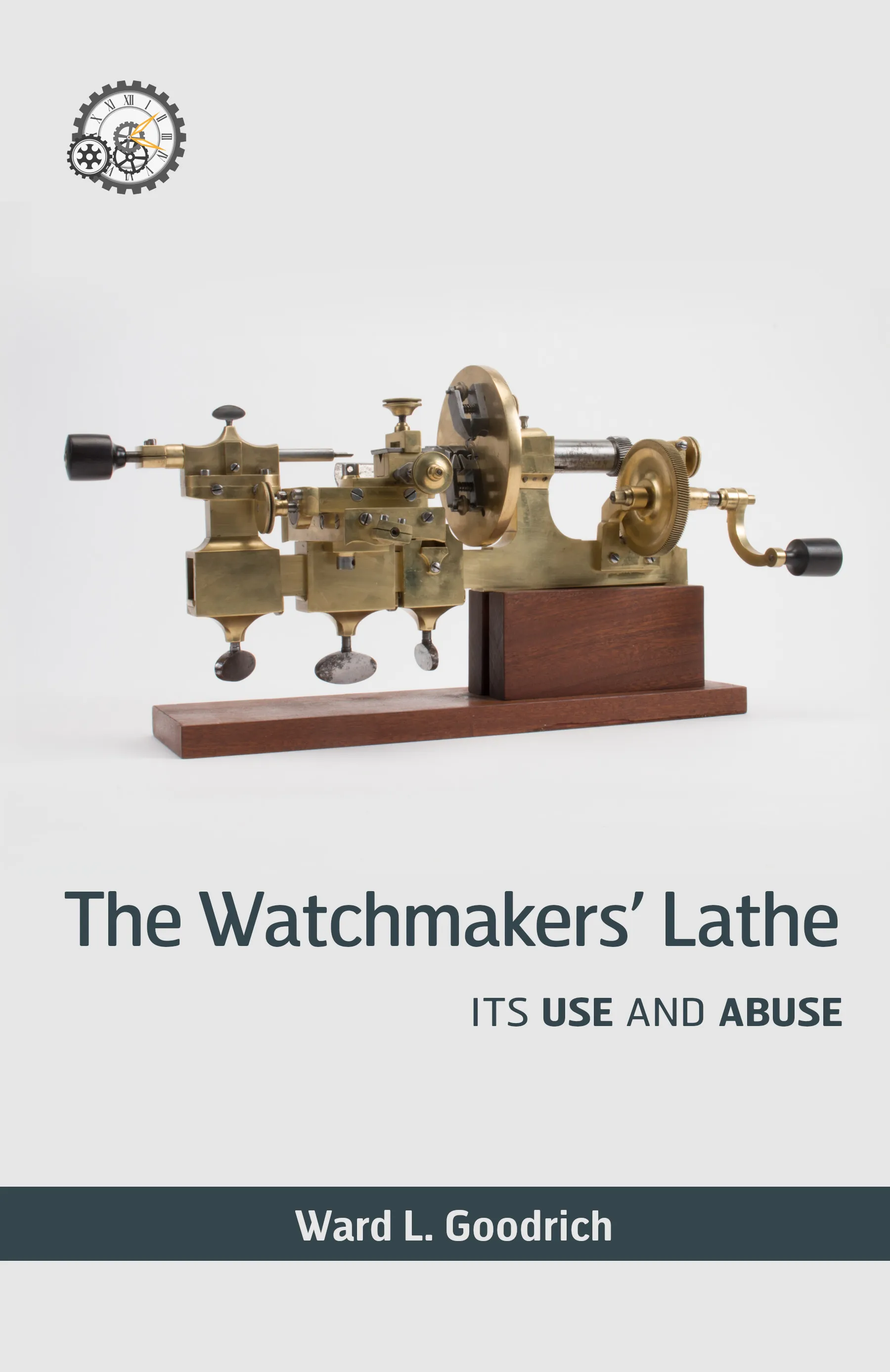
232 pages | Published 11/24/2024
Recommended for: craftsmen
First published in 1903, The Watchmakers’ Lathe: Its Use and Abuse remains the foundational English-language reference on the American watchmaker’s lathe. Ward L. Goodrich—better known today for his standard The Modern Clock (1905)—wrote it for “the student and apprentice” at a moment when factory-made movements were everywhere and the quality of apprentice training was visibly slipping.
Goodrich works through the construction of the lathe and each of its principal components—split chucks and collets, face plates, cement chucks, hand rests and slide rests, tailstocks, cutters and drills, wheel-cutting attachments, steady rests, idler pulleys, foot wheels, and the watchmaker’s bench itself—and at each stage contrasts correct procedure with the misuse he saw at the bench: chucks sprung by overtightening, cement work done badly, gravers held wrong. The discussion is anchored on the American Webster-Whitcomb pattern (originated at the American Watch Tool Co. of Waltham) and the Moseley lathe of Elgin, the two lathes that defined American bench practice in the period.
Not a how-to manual on turning technique so much as a thorough examination of the tool itself and what it can and cannot be made to do. Still the first book to reach for when learning what a watchmaker’s lathe is.
© Copyright 2026 Horological History. All rights reserved.
ContactYour cart is empty